


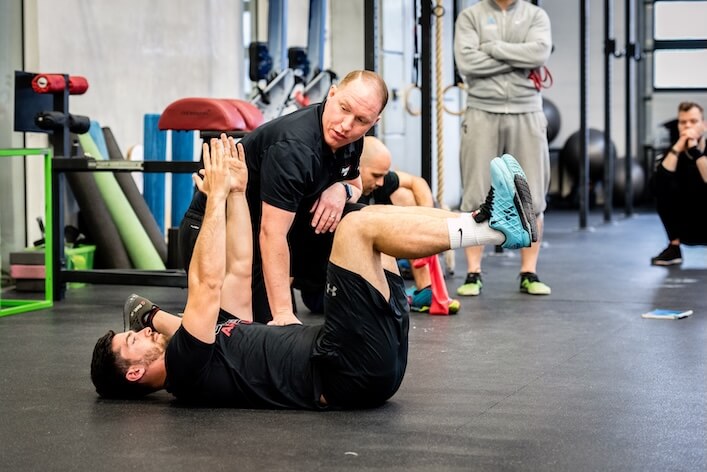
Over the last couple of weeks I’ve gotten a TON of questions about my upcoming Optimizing Movement Workshop.
And with the super-early bird discount (and $200 savings) going away on Friday, 2/27 at midnight, I figured there’s no better time than NOW to give you a step-by-step breakdown of the weekend.
So without any further ado, let’s dive in!
Section #1: The Movement Model
One of the things that I’ve really tried to understand over the past 25 years isn’t just how we move, but why we move the way we do.
For instance, when you’re getting started it’s all chest workouts and biceps exercises…
…but over time (hopefully) you start to ask some better questions.
Questions like:
- Why are some people better squatters or deadlifters?
- How does gravity impact our movement? Or maybe the exercises that work best for a specific client?
- What does breathing have to do with all this?
- Why is gait important? And how can understanding gait help us better prescribe exercises?
- Is there such a thing as “perfect posture?” And if not, what kind of alignment should we aspire to achieve?
- And finally, what are the buckets that every client and athlete we train should try to fill?
You see, the longer I do this, the more I think we learn about exercise backwards.
We learn a bunch of exercises, maybe how to coach and cue them, but there’s no overarching model as to WHY we move the way we do.
This is my goal – to help YOU better understand how and why we move, so that ultimately, you can make better choices with every client and athlete going forward.
Section #2: Real World Assessments and Program Design
Raise your hand if you’ve done this before… (I’ll go ahead and raise mine now)
Spend a long weekend – or weekends – at a course learning about assessments.
Learn everything there is to possibly know about assessment X, Y and Z.
Be super excited about all the new things you learned.
Get home, start using new assessment process, only to realize it still doesn’t help you write a better training program?!?!!?
Yes, this has happened to me numerous times over my years.
Here’s the issue: These types of courses are selling a stand-alone assessment process.
They’re NOT selling you an assessment process that’s designed to help you write more individualized training programs on the back end!
Over the years, I can’t tell you how many times I’ve talked with trainers and coaches who:
- A) Know they SHOULD be assessing their clients and athletes, but also
- B) Are so utterly confused about WHAT to do they actually hate doing it – or have flat-out stopped altogether!
And trust me, I get it – because we were there as well.
 At IFAST, we did spent a year doing the FMS.
We spent another year (or more) with our personal training clients and athletes lying on a table, trying to unlock 5-10 degrees of IR.
And I’m not going to tell you those things are bad, or that they maybe don’t work.
What I will tell you is those tools didn’t work FOR US.
If you have a client who wants to build muscle, or lose 5-10 pounds…
…or if you have a young athlete who wants to get bigger, faster or stronger…
…they don’t want to overhead squat with a stick over their head, or spend an hour on a treatment table trying to find the perfect breathing exercise for them.
They want to go through an assessment that looks and feels like exercise, and that accurately reflects what they’re going to do when they start working out with you!
So in this process, yes, we’re going to break down squatting, hinging, lunging, etc. – because I think that part is critical.
But we’re going to do it in such a way that it actually write the program for you.
I’ve done this with my last couple of seminars, and I think this may be one of the best part of the course.
Because now you’re not just assessing to check the box of “I do an assessment.”
Now you’re assessing with purpose and intent.
And ultimately, that assessment is literally going to write the client’s training program for you!
Section #3: Unlocking Your Coaching and Cuing Skills
Here’s a random question I’m not sure you’ve thought about lately:
When was the last time someone helped you train your eyes as a coach?
If the answer is, “it’s been a while” – trust me, I get it.
But if the answer is “never” – then we need to talk.
If you want to become a more effective coach on the floor, there’s really three steps to that process:
- Knowing WHAT you’re seeing. Is their torso caving over? Knee collapsing in? Pelvis dumping forward? Once you know what you’re seeing, the next step is…
- Understanding WHY you’re seeing it. This comes back to our movement model and assessment. If you understand why someone is moving or compensating in a certain way, you can create strategies and interventions to fix it. And then finally you have to
- Give them an effective strategy to fix the issue! In many cases, this is a coaching cue. “Think long and tall.” “Strong foot and keep your knee out.” Or in some cases, it may be realizing that the exercise you originally chose isn’t best, and finding an alternative that works better.
But again I’ll ask you – when was the last time you worked through this process with someone?
 In real time?
This is something that we did with every one of our coaches and interns at IFAST, and I think it’s arguably one of the most impactful things you can do as a coach.
One thing I’m still reminded of today is when Pete Dupuis (co-owner of Cressey Sports Performance) took two of our former interns on as interns at CSP.
I was shocked because I knew how hard it was to get one of those internships, and here he had taken not one but TWO of our guys.
nd he gave me one of the best compliments a guy could get it:
“Mike, your guys just come ready to coach.”
And that was a serious proud dad moment for sure!
Summary
So there you have it my friend, a quick, step-by-step breakdown as to what we’re going to cover – and how we’re going to cover it – at my Optimizing Movement Workshop.
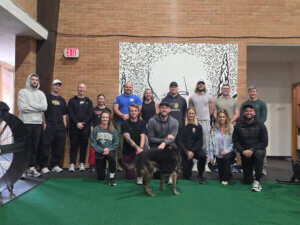 Now like I’ve mentioned numerous times now, I’m not going to be doing too many more of these.
And furthermore, the super-early bird discount ends on Friday night at midnight, EST.
Can you get in after that?
Sure – but why not save some of that hard-earned money?
I guarantee this workshop is going to help you level up as a trainer or coach, and we’re going to have a ton of fun along the way.
To learn more, just visit the link below:
The Optimizing Movement Workshop
Thanks so much for reading and let’s MAKE IT a great day!
All the best,
MR