


We’ve worked so hard to move past the idea that a woman’s worth is measured in how small she is.
I’ve spent years helping women untangle the belief that smaller equals healthier. Equals happier. Equals more worthy of taking up space in the world.
And we’ve made progress! The conversation about body image, about strength over shrinking, about nourishing rather than punishing…that conversation shifted.
With the rise of GLP-1’s, while there is hope for many from a medical standpoint, from a marketing standpoint, I’m concerned by the direction we’re headed.
The weight loss ads are once again inescapable.
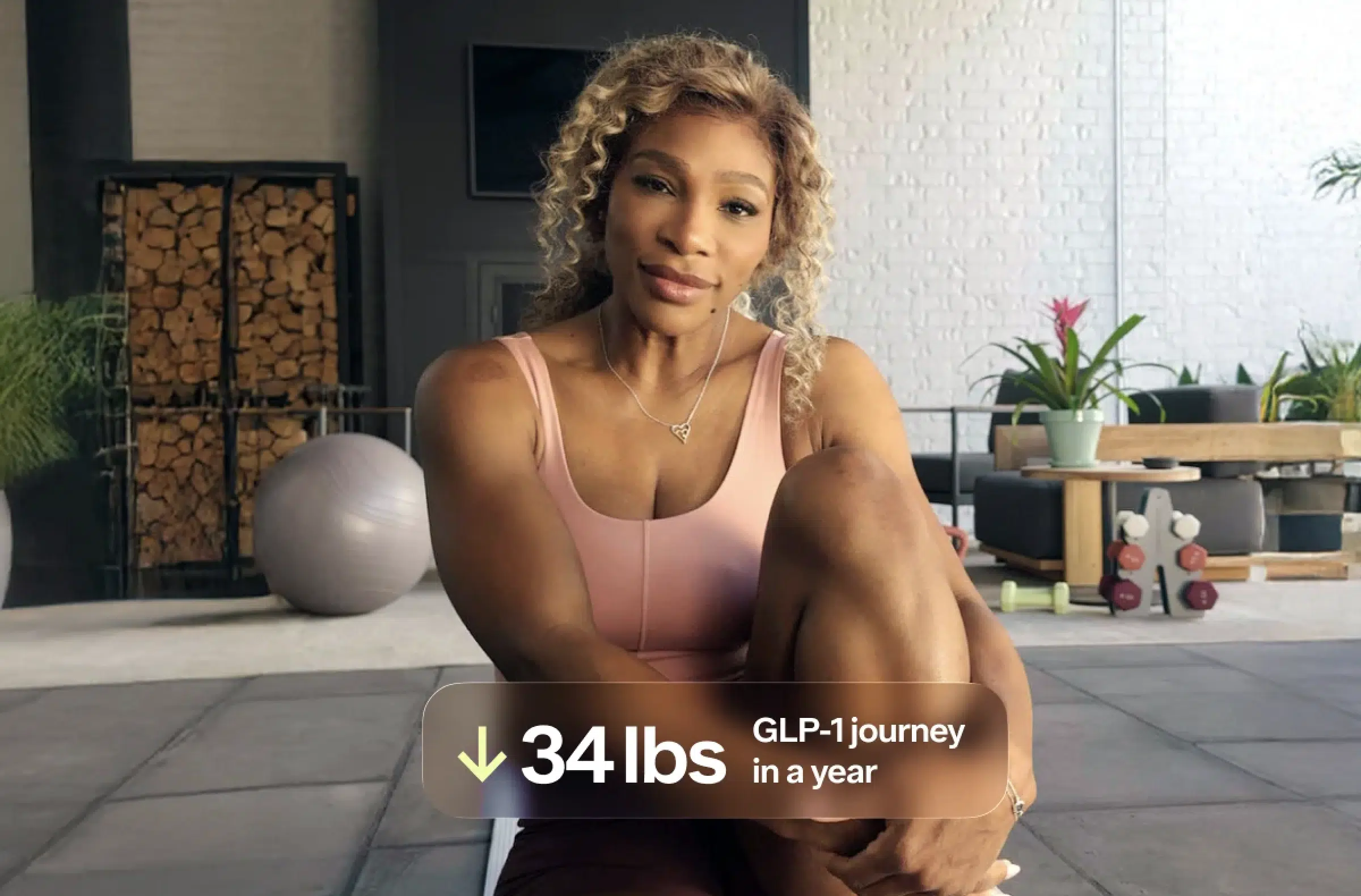
A few weeks ago, I was curled up on the couch with my kids when Serena Williams appeared on the screen. I assumed it was going to be an ad about strength, about athleticism, about all the things she represents as one of the greatest athletes of our time.
Instead, it was an ad for Ro, a telehealth company that sells GLP-1 medications. She injected herself on camera and said, “It’s not a shortcut. It’s science.” (No mention of deeper health concerns, no discussion of her health as a whole, just a pure focus on her weight loss.)
I audibly groaned.
Not because I’m anti–GLP-1. I’m not. I want to be really clear about that from the start.
But because weight loss advertising is once again everywhere and my kids were right there watching with me.
(Side note: I paused the TV and we had a little conversation about how ads are always trying to sell us something, and that getting smaller doesn’t automatically mean getting healthier – and we don’t know her full story. Also that Serena is being paid to make this commercial and that her husband is an investor in Ro. Worth knowing.)
I’ve been sitting with this topic for a while now, turning it over, researching, taking in multiple points of view, trying to find the right words. Because I don’t want to be dismissive and I don’t want to be alarmist.
But I do think this conversation needs more nuance than what we’re currently getting – so today, I’m sharing my honest take on GLP-1s.
But first, what are GLP-1s?
GLP-1 stands for glucagon-like peptide-1, a hormone your body naturally produces after you eat.
Its job is to slow stomach emptying, increase insulin release, reduce blood sugar, and signal fullness to your brain.
GLP-1 medications are designed to mimic this hormone. The medications are synthetic compounds engineered to:
- Last much longer than natural GLP-1 (which breaks down in minutes)
- Be more potent than what your body naturally makes
- Resist degradation so they can be injected weekly instead of constantly produce.
So while they’re based on a naturally occurring hormone in the body, the actual medications are manufactured pharmaceutical compounds — not extracted from natural sources.
They were originally developed for Type 2 diabetes and some are now approved for chronic weight management. Examples include Ozempic, Wegovy and Mounjaro.
What I’m genuinely encouraged by…
Let me start here, because I think it matters: for people living with obesity, Type 2 diabetes, and serious metabolic disease; people who have felt completely stuck despite their best efforts, GLP-1 medications provide a lot of hope.
I’ve seen how debilitating metabolic dysfunction can be. It creates a cycle that is incredibly hard to break.
These medications can interrupt that cycle.
They can open a door that has felt sealed shut. And for many people, they can be the catalyst that makes other healthy lifestyle shifts finally feel possible.
I know some of you are on GLP-1s and seeing real benefits (better energy, improved labs, the ability to move more freely) and they have helped you embrace additional lifestyle changes that are helping you feel your best.
That’s wonderful, and I’m genuinely happy for you!
As I share my concerns, know they’re not about your choice, they’re about how as these medications become mainstream, they are increasingly being marketed and prescribed without the kind of care we all deserve.
Where my concern is increasing…
What started as a promising medication for people with significant health conditions has rapidly become a mainstream weight loss trend.
And with an enormous amount of money to be made, the guardrails are coming off fast. (Companies, brands and influencers are flocking to get in on the money that can be made in this category right now.)
My growing concern is that GLP-1s are now being marketed more like a supplement than a medication.
Like something anyone and everyone should use. Something you just add to your routine…in the same way you might add a protein shake.
And THAT genuinely concerns me.
Because these are not supplements.
They are medications, and they come with real considerations that aren’t making it into the Instagram ads and stories we swipe past daily.
A friend recently told me she went to her doctor to discuss concerns about weight gain. Before running any blood work. Before taking her health history. Before asking what she’d already tried, her doctor immediately recommended a GLP-1.
That stopped me in my tracks. That is not how this should work.
This is an example of how inconsistent the standards of care are right now.
We all deserve doctors who take the time to truly understand the picture of our health before prescribing medications and GLP-1s are no exception.
A few things I keep coming back to…
Nutrient deficiency is a real risk
As a nutritionist, I know how hard it already is for most women to get adequate nutrition from their diet – even when they’re eating well and eating enough.
When you add a powerful appetite suppressant to the mix, you significantly reduce the chance that your body is getting the minerals, vitamins, and protein it needs to thrive.
We’re talking potential hair loss, bone loss, and not giving your brain the fuel it needs to function at its best.
These are not minor side effects.
We are talking about your quality of life beyond menopause and your overall longevity. It’s important because what you do now has a direct impact on your future body.
For women especially (particularly those of us navigating perimenopause, hormonal shifts, and the very real changes that come with midlife) adequate nutrition is foundational.
My concern is that not every provider is having the conversation about nutrients and muscle maintenance – and without that guidance, health can actually decline even as weight comes off.
And the more companies that hop on the bandwagon of selling this medication, the fewer conversations are even happening and the less guardrails there are in the industry as a whole.
These things matter significantly for long-term health.
Muscle loss matters more than we think
As women, we already lose muscle mass as we age. It’s one of the reasons I talk so much about the importance of strength and movement as we get older.
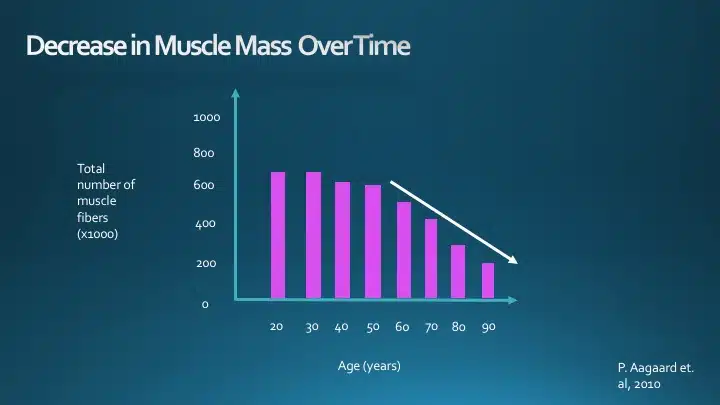
Muscle is not just about aesthetics. Muscle protects your metabolism, your bone density, your energy levels, and your long-term independence.
Research shows that GLP-1 medications can accelerate muscle loss alongside fat loss.
That trade-off has long-term consequences that aren’t being discussed loudly enough, especially for women in their 40s and 50s who are already working against that tide. Muscle becomes increasingly difficult to build as we age, even without medications.
If weight loss occurs, but strength declines as well – is it truly worth it? If you’re taking a GLP-1 primarily for weight loss and not disease, this is a question worth asking.
What happens when you stop?
This is the question I don’t see enough people asking before they start: what’s the plan long term?
These are expensive medications, and insurance coverage is inconsistent. Many people simply can’t stay on them indefinitely.
Research is clear that when people stop taking GLP-1s without a solid lifestyle foundation in place, weight often returns, and typically more than before.
That’s not a failure of the person. That’s what happens when a medication fills a gap instead of supporting a larger shift in lifestyle changes.
Before starting, this conversation needs to happen, openly and honestly, with a provider who actually knows your full picture.
If you’re taking a GLP-1, continue to prioritize your nutrition, your workouts, your sleep and the lifestyle habits that will serve you for years to come. This will always be necessary and the benefits go far beyond weight loss.
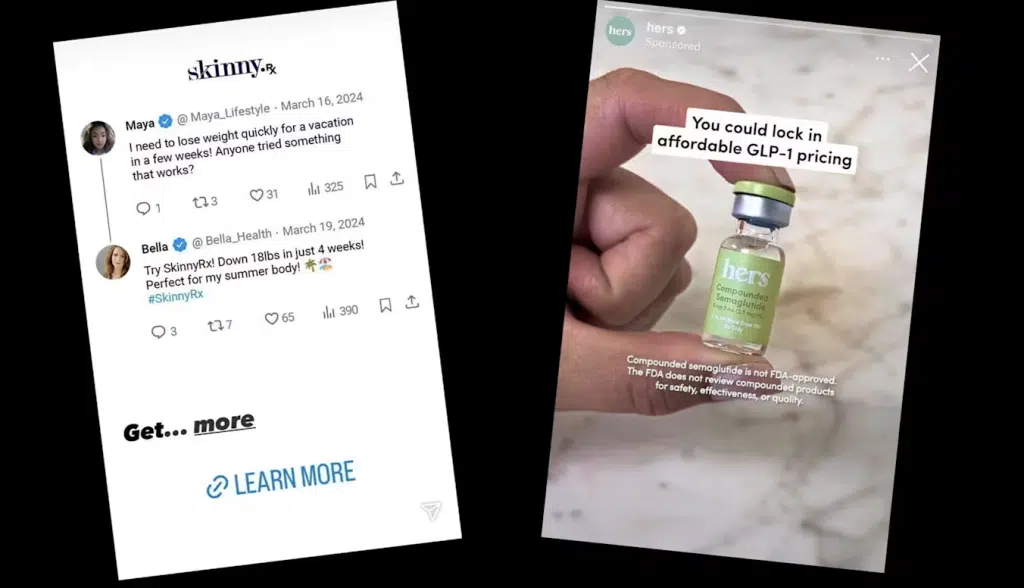
And there’s so much more we need to discuss…
I have other concerns but going into detail on each one would require me to write a book and I know you have other things to do with your day today. 🙂
So for now, I’ll say that there are several other areas that need careful attention as GLP-1s become more mainstream:
Eating disorders and disordered eating: Now that essentially anyone can become an affiliate and sell these medications online, oversight is going way down.
For someone with a history of disordered eating, this could be genuinely dangerous. This needs more protection, not less.
Young people and the next generation: I’ve spent more than a decade pushing back on the idea that smaller always equals better or healthier.
Watching Hollywood, social media, and now the people around us get drastically smaller (and seeing it celebrated) worries me deeply for the girls watching.
This adds to an already heavy pressure. More to come on this in a future email.
My deepest concern: the increasing pressure for women to shrink
The message is the same one we’ve been hearing our whole lives: you need to be smaller.
What was originally clinical is now also being dressed up as a quick-fix and aspirational.
It’s being endorsed by women we admire and it’s being promoted by (already thin and healthy) influencers that our teenagers look to for advice.
To be clear…can someone be thin and healthy? Of course. Can weight loss be a part of getting healthier? Absolutely!
But as I’ve been saying for years, weight is one data point among many.
Weight loss alone doesn’t automatically make someone healthy. And the pressure on women to make themselves smaller to fit the societal norm, has been exhausting and unhelpful.
So what do I want you to take away from all of this?
If you’re in a situation where a GLP-1 medication is or could be a part of a thoughtful, medically supervised health plan, I want you to feel supported in exploring that.
I encourage you to do it with a provider who knows your blood work, your history, your mental health, and your goals (not an influencer or an app that asks three questions and mails you a subscription).
I encourage you to ask questions, push for blood work and have a plan to build muscle and nourish yourself well in the process.
And if you don’t have a medical need, but you’re seeing the ads and the before-and-afters and feeling like maybe you should be getting smaller too, I want you to pause.
Come back to yourself.
Ask yourself what you actually want and what health actually looks like for you. Not what’s being sold to you.
You deserve more than another company profiting off of the pressure you feel to be smaller.
You deserve to be genuinely supported in your quest to become healthier, stronger and more vibrant – whatever path that looks like for you.
As always, I’m here, navigating all of this right alongside you and Lindywell will always be about supporting you to feel strong, vibrant and truly well.
This is a topic I’ll be coming back to, because there’s so much more to say. Comment and let me know what questions you’re sitting with – my team and I read every single one.
Sources:
Image: https://larsonsportsortho.com/exercise-after-60/
Image: https://www.ro.com
Magic Pill by Johann Hari