


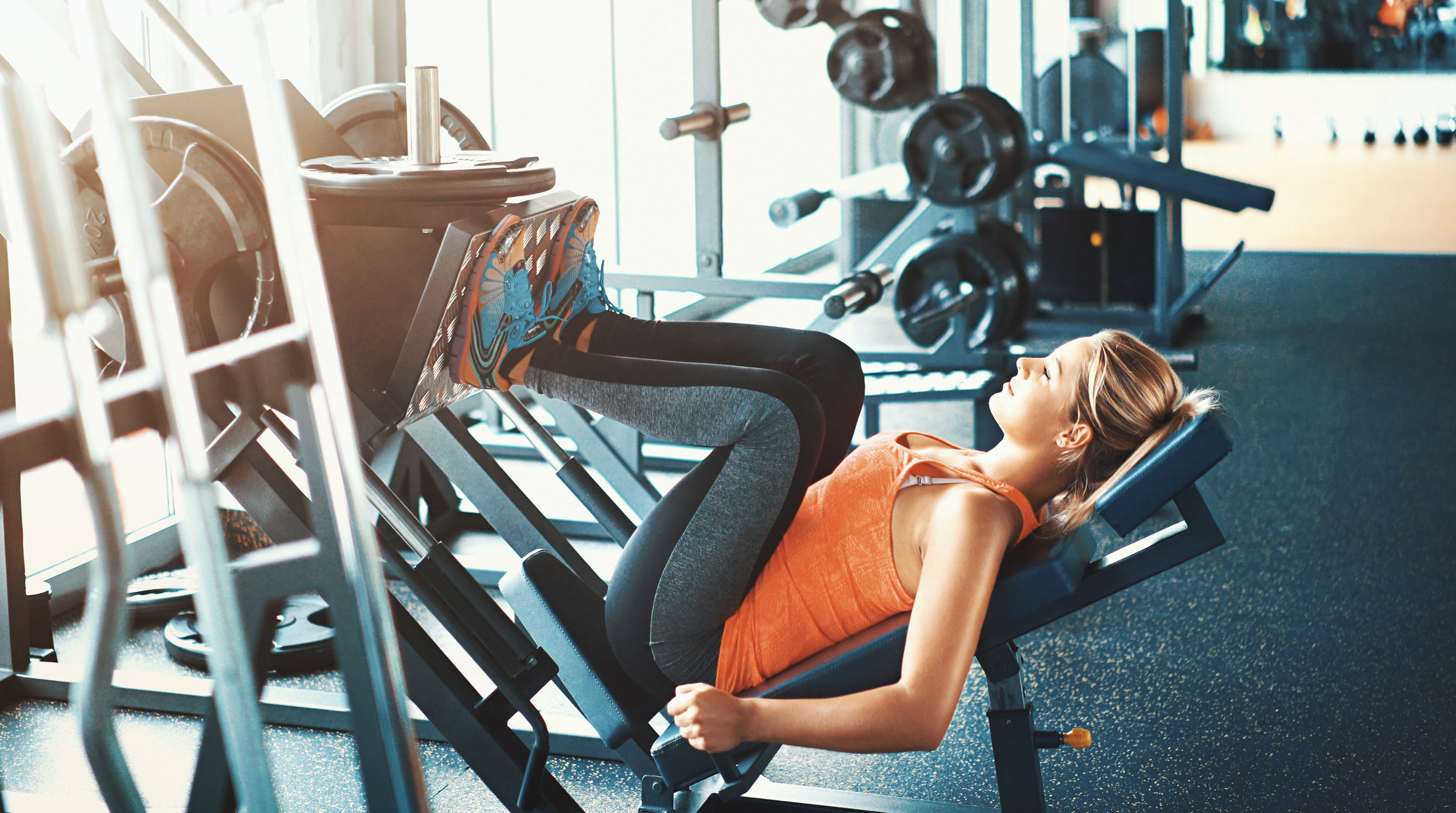
While many clients may want to build bigger glutes for aesthetic reasons, these muscles also play a number of essential functional roles. The glutes (i.e., the gluteus maximus, medius and minimus) are prime movers in extension, abduction and internal and external rotation of the hips.
In other words, strong glutes are crucial not only for everyday tasks like walking, jumping, squatting and climbing stairs but also for sports-related movements like side lunges, swinging a golf club and throwing a softball. In addition, the glutes are essential for pelvic and core stability, postural support, injury prevention and balance.
Anatomy of the Glutes
This illustration shows the posterior musculature of the hip and knee, including the gluteal muscles and the hamstrings muscles.
To address the need for exercises that safely and effectively build stronger glutes, ACE-sponsored research evaluated eight different exercises to determine which ones best targeted this muscle group. The researchers began by evaluating each of the study’s 12 participants’ one-repetition maximum (1-RM) on the following exercises:
|
|
*No 1-RM was recorded becuase these exercises use body weight as resistance.
On two subsequent workout sessions, researchers placed electromyography (EMG) electrodes on the gluteus maximus, gluteus medius and the hamstrings* muscles of each participant. The participants performed a 1-RM of the traditional squat, followed by a set of five repetitions of each of the other seven exercises. When appropriate, these sets were performed at 80% of each participant’s 1-RM.
*While the hamstrings are not gluteal muscles, they are synergists with those muscles, as they are all hip extensors. The gluteus minimus was not included because this muscle is deep to the gluteus maximus and cannot be tested with surface electrodes.
Researchers then compared the amount of muscle activation for each exercise to that seen with the traditional squat. Here is what they found for each muscle and muscle group tested:
- Gluteus maximus: All exercises elicited similar muscle activation, with the exception of the horizontal and vertical leg press exercises, both of which elicited significantly less.
- Gluteus medius: Quadruped hip extensions, step-ups and lunges generated significantly more muscle activation than squats, while the horizontal and vertical leg press exercises again elicited significantly less.
- Hamstrings: Quadruped hip extensions, step-ups, lunges and hip extension on the multi hip machine garnered significantly more EMG activity than squats, with the horizontal and vertical leg press exercises once again eliciting the least amount of effort.
The bottom line is that five exercises emerged as effective alternatives to traditional squats: single-leg squats, quadruped hip extensions, step-ups, lunges and hip extension on the multi hip machine. It makes intuitive sense that multiple exercises would be effective in slightly different ways, as the glutes are a large muscle group. Fortunately, they’re also easy to isolate through training.
The researchers suggest focusing on the results for the gluteus maximus, which is most important to strength development of the glutes overall. Nearly all of the exercises showed statistically similar muscle activation for the gluteus maximus, though the quadruped hip extension and traditional squat showed the highest level of effort. The quadruped hip extension, which is a body-weight exercise, can be progressed with the addition of ankle weights, making it a good option for anyone who needs an alternative to the squat.
The optimal approach might be to mix and match all eight of the exercises included in this study when programming glute workouts, to not only provide variety to the routine, but also to target the muscle group in different ways and avoid overuse injuries.
The researchers note that the horizontal and vertical leg press exercises should not be dismissed based on the results of this study, as these machines provide a stable environment where exercisers, particularly beginner exercisers, have complete control over the range of motion.
Expert Advice
In the interest of providing options for clients, we asked two experienced ACE Certified Pros for their favorite glute exercises.
Allyson Murray, ACE Certified Personal Trainer and Health Coach, chose deadlifts and lunges as her preferred options for intermediate to advanced exercisers. Beginners can first perform hip hinges with a dowel along the spine and no external resistance in order to learn proper form, as good postural alignment should be achieved before adding weights.
Mann San Gil, who has been an ACE Certified Personal Trainer for 24 years, says that his favorite exercises for the glutes are squats and quadruped hip extension. San Gil points out that you can hold dumbbells at your sides while doing the squats and add ankle weights or an elastic band to the quadruped hip extension to provide an additional challenge and more resistance. “These exercises are effective because they’re extremely targeted,” he explains.
San Gil says that these exercises are appropriate for people of all experience levels, as long as they don’t have any prior injuries. Both exercises can be modified by using only body weight and decreasing the range of motion.
Final Thoughts
Performing several different exercises is essential when training the glutes, as they form a large muscle group and drive a variety of movements. Researchers suggest mixing and matching all eight exercises they evaluated in their study, and our experts added a few more options to the mix:
| you are an exercise professional interested in designing safe and effective resistance-training programs for your clients, check out these two Specialist Programs: |
 |
Corrective Exercise (worth 2.5 ACE CECs): As an ACE Corrective Exercise Specialist, you will design programs for clients affected by chronic conditions or injuries, empowering them to regain daily function and move with confidence. |
 |
Pain-Free Movement (worth 1.2 ACE CECs): As a Pain-Free Movement Specialist, you will better understand how pain affects movement and how to create new strategies to help people move without pain. |