


When sciatica first hit me at 56, I pulled up the YouTube list of recommended sciatica stretches and started bending into shapes I had no business attempting before coffee.
Two weeks later I could barely get out of a chair. The stretches I had treated as gospel were the ones I should have avoided first.
Here is what nobody had bothered to tell me. Sciatica is not one condition. It is a description of where the pain travels, and the same stretch that helps one cause can make another cause worse. After 50, the margin for error gets thinner. Discs are drier, joints are stiffer, and the nervous system is less forgiving than it was at 35.
If you are reaching for the foam roller and the yoga mat, here is the part I wish I had known first.
Why Some Sciatica Stretches Are the Ones to Avoid
Sciatica describes where the pain travels, not what is causing it. The two most common causes after 50 are a bulging or herniated disc and piriformis syndrome, and they respond to opposite movements. Stretches that decompress a disc can flare a piriformis. Stretches that release a piriformis can press a disc deeper into a nerve. Knowing which side of that line you are on changes everything.
The simple test: if forward bending makes the pain travel further down your leg, you probably belong in the disc category. If twisting and deep hip stretches reproduce the pain, piriformis is more likely. If in doubt, ask a physical therapist, not a YouTube video.
5 Sciatica Stretches That Often Backfire After 50
The five stretches below show up in nearly every “do this for sciatica” video on the internet. None of them are wrong for everyone. But each one has a specific scenario where it makes the problem measurably worse, and after 50 those scenarios are more common than the average instructor admits.
1. Standing Toe Touches (Forward Fold)
Reaching for your toes from a standing position deepens spinal flexion, which pushes the soft inner part of a lumbar disc backward toward the nerve. If your sciatica started because a disc is bulging or herniated, and most after-50 sciatica does, this is the worst possible direction to load. The Mayo Clinic notes that movements which increase disc pressure are the ones most likely to provoke a sciatic episode.
If you stand up after a toe touch and the pain has shifted further down your calf or foot, that is the disc telling you it did not appreciate the gesture.
2. Seated Forward Bend
Sitting on the floor and reaching for your toes looks gentler than standing, but for a lumbar disc it is worse. The seated position locks the pelvis, so all the bend has to come from the lower back. The lumbar spine ends up in deeper flexion than it would standing.
I have a friend with a confirmed L5-S1 herniation who did this stretch every morning because his yoga app told him to. After three weeks he ended up in an MRI tube wondering why the numbness was now reaching his big toe.
3. Cobra and Sphinx (When Stenosis Is the Cause)
Cobra is often recommended for sciatica because it does the opposite of forward folding. For a herniated disc, that is helpful. For spinal stenosis, which is the narrowing of the spinal canal that becomes more common after 60, it is the wrong direction.
Stenosis-related sciatica gets worse with extension and better with flexion. People with stenosis usually feel relief leaning over a shopping cart and pain when standing tall or arching backward. Cobra pose is essentially asking the spine to arch backward against gravity, which can compress an already-narrowed canal further.
4. Aggressive Pigeon Pose
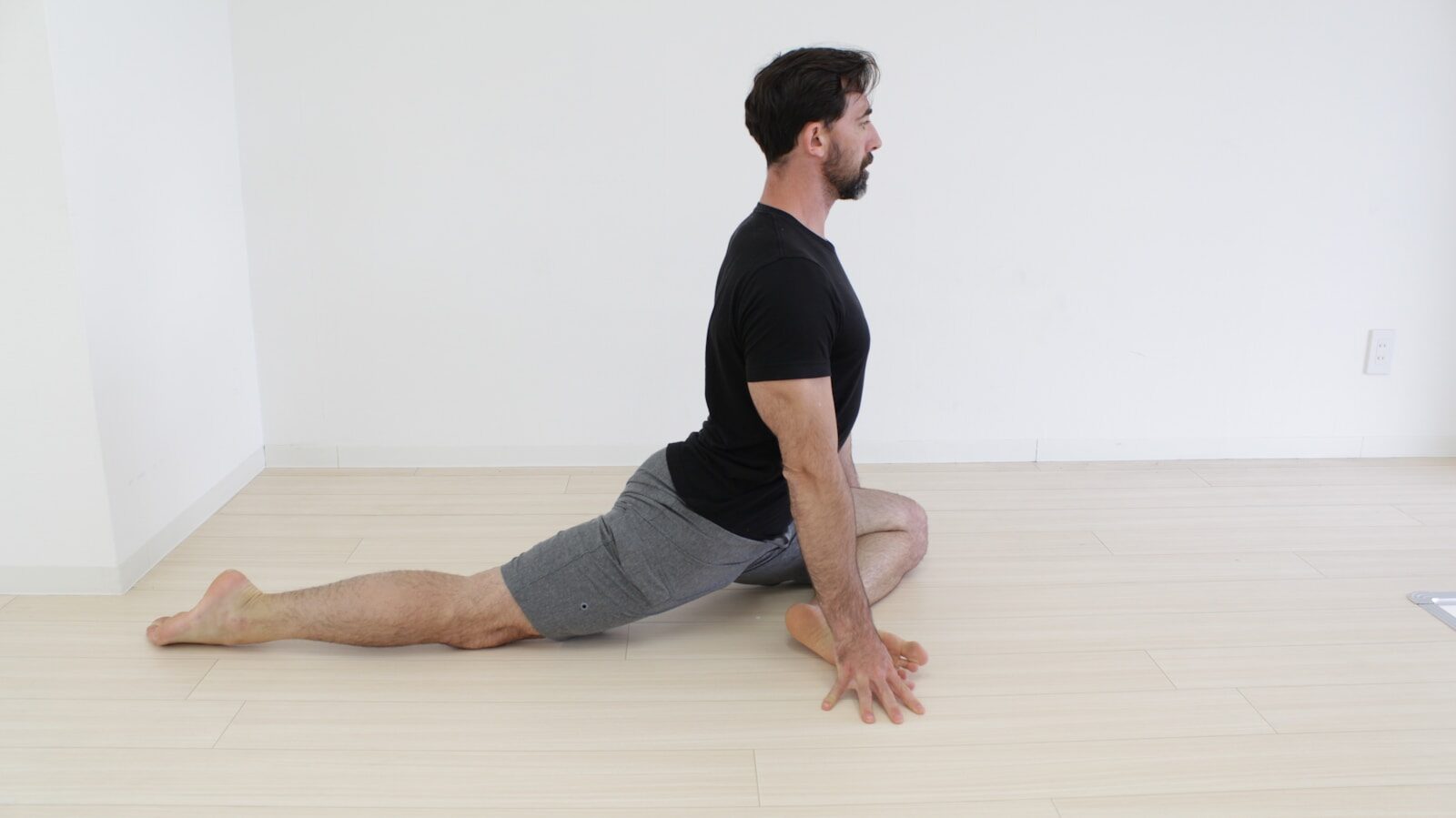
Pigeon is a legitimate piriformis stretch. The problem is not the pose, it is how it is usually performed. Dropping the front knee out, leaning forward over the leg, and bouncing into the stretch can pinch the sciatic nerve where it runs through or near the piriformis muscle.
If pigeon makes the pain shoot down the leg rather than feel like a deep stretch in the glute, you are stretching the nerve, not the muscle. The nerve does not like being stretched. It likes being slid, gently. A 60-second hold of bouncing pigeon does the opposite.
5. The Seated Spinal Twist
The seated spinal twist looks innocuous and feels productive. After 50, it can be neither. The combination of flexion (you are rounded forward to twist) and rotation puts a lot of shear force on lumbar discs that already have less water in them than they did a decade ago.
If you are going to twist, do it lying on your back with your knees together and your shoulders flat on the floor. Same intent, a fraction of the load.
What Actually Helps (Without the Risk)
Three movements have held up across the research and across my own trial and error after 55. None of them are flashy. All of them are gentler than they look.
McKenzie press-ups. Lie on your stomach, place your hands under your shoulders, and gently press your chest off the floor while letting your hips stay heavy. Hold for two seconds. Lower. Repeat ten times. For disc-related sciatica, this is the most widely studied exercise that consistently helps. A 2014 study in the Journal of Orthopaedic and Sports Physical Therapy found McKenzie-method exercises superior to comparison treatments for centralizing leg pain. If your symptoms travel back up the leg toward the spine while you are doing the press-ups, that is a good sign. That movement is called centralization, and it means the disc is moving away from the nerve.
Walking. Boring, I know. But walking decompresses the spine, lubricates the discs, and engages the deep core muscles that protect the lumbar region. Twenty minutes of easy walking does more for most sciatica than thirty minutes of aggressive stretching. I wrote about the broader benefits of a daily walk after 55 here, but for the nerve specifically, walking is a quiet hero.
Side-lying piriformis release. Lie on your unaffected side, place a tennis ball or a softer therapy ball under the belly of the piriformis (back pocket area, not the hip bone), and let your body weight do the work. Two minutes per side. No bouncing. No grinding. The muscle releases when it feels safe, not when you punish it.
When to Stop Stretching and Call a Doctor
Some sciatica is a stretching problem. Some sciatica is a nerve emergency. Knowing the difference matters. Stop everything and call a doctor the same day if you have any of the following: numbness in the saddle area (groin, inner thighs, or buttocks), loss of bladder or bowel control, sudden urinary retention, weakness in the foot that makes you trip or drag your toes, progressive weakness in the leg over hours or days, or severe pain that does not ease with any position.
Those are signs of cauda equina syndrome or a major nerve compression that needs medical attention. The MedlinePlus guidance on sciatica is clear that these symptoms are not stretchable problems. Get checked.
For the 90% of cases that are not emergencies, the broader picture matters too. I have written before about how joint pain after 50 is often misidentified nerve pain, and sciatica is the headline case. Treating it like a tight hamstring problem when it is actually a nerve problem is how you spend two weeks getting worse.
Frequently Asked Questions About Sciatica Stretches
Is it bad to stretch sciatica?
Stretching is not inherently bad for sciatica, but the wrong stretch for your specific cause can make symptoms worse. Disc-related sciatica gets worse with deep forward folding. Piriformis-related sciatica can flare with aggressive nerve-stretching poses. The right approach starts with knowing which type you have.
What is the worst stretch for sciatica?
The standing toe touch is the most commonly recommended and most commonly harmful stretch for disc-related sciatica, which is the most common form after 50. Deep spinal flexion against gravity pushes the disc material backward into the nerve. If your pain is sharper after a forward fold than before, that is the disc objecting.
How long should I stretch sciatica each day?
Less than most people think. Five to ten minutes of gentle, targeted movement done two or three times daily is more effective than one long session. The goal is to keep the area moving and decompressed throughout the day, not to fix it in a single session.
Should I stretch through sciatica pain?
No. The rule of thumb is that movement should reduce or centralize the leg pain, not increase or extend it. If a stretch makes the pain travel further down the leg, that stretch is wrong for your specific case. Stop, change positions, and try something else.
Can sciatica heal without stretching?
Yes, often. Most sciatica resolves within six to twelve weeks regardless of treatment. Walking, gentle movement, anti-inflammatory diet, and time do most of the work. Stretching can speed it up when targeted correctly, but it is not required for recovery.
Want what I'm finding?
One email a week. The research I'm digging into and what's actually working after 40. No noise.