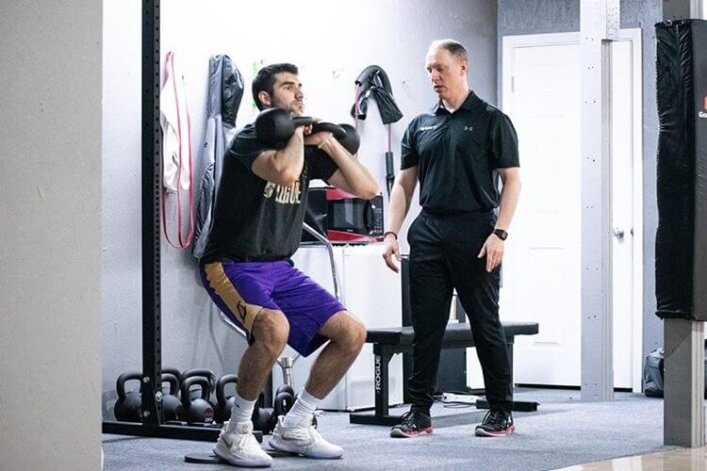
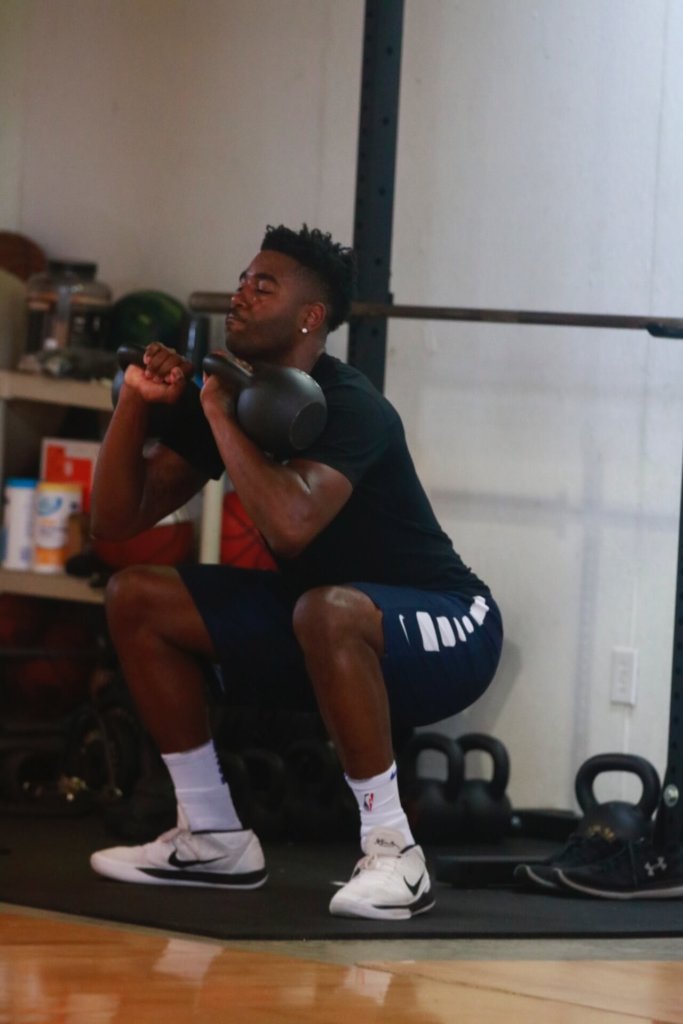
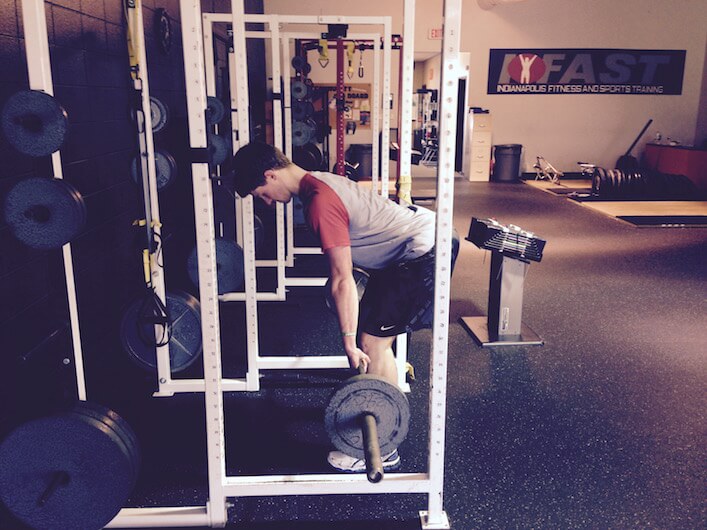
Lately, it seems like there’s a big debate online as to whether you should squat OR deadlift.
And I get it – people DO love to argue on the Internet.
Because why would you do something crazy like go sit down with another human being, talk face to face, and maybe agree that both people’s opinion have merit???
But I digress…😉
Will we have movement preferences and biases based on our body shape, archetype, and movement history?
Of course.
Before we had narrow and wide ISA’s, or muscular versus elastic archetypes, we simply had people that worked out…
…and some were better at squatting, and some were better at deadlifting.
Crazy, right?
Think of it as a spectrum – most of us will be skewed one way or the other, but we can at least TOUCH both sides to a degree
And in fact, I think there’s value in exploring the opposite range, as it will allow us to create some adaptability in our system.
So I believe that both squatting AND deadlifting are valuable, whether your goal is to be a more resilient and robust athlete, or a harder-to-kill human being.
Now if you want a quick breakdown of the differences between the two, I think this short video will help:
But let’s look at this pragmatically, and discuss the the benefits of both!
3 Reasons We Should Squat
Vertical Force Production
Let’s start easy, and we can get more nuanced from there.
If you play sports that require how amounts of vertical force production (think basketball, volleyball, etc.) it behooves you to unlock and train your squat pattern.
The ability to lower your body rapidly, control/own it, and then use that energy to explode upwards and defy gravity is something that many athletes need to work on.
Like I said we’re starting easy. Now let’s talk about…
Triple Flexion
When I was coming up as a strength coach, it seemed like everyone was talking about triple extension, or the ability to rapidly extend the ankles, knees and hips.
So whether it was box jumps, Olympic lifts, accelerations or anything in between, if you were training triple extension, you were going to help your athletes get faster and more explosive!
But this also made me think…
We’re so focused on improving strength and power with triple extension, shouldn’t we be more focused on managing and controlling forces by having access to – and strength in – triple flexion?
As injury rates continue to rise, I wonder if placing a premium on improving triple flexion could help us brake more effectively, and distribute those forces across multiple joints and tissues.
Furthermore, one of the most common complaints I get from young and old athletes alike is that they want more mobility in their ankles, knees and hips.
So while I’m all for making faster, stronger and more powerful athletes, we need to see both sides of that coin.
Quite simply, I think the ability to squat and display triple flexion (with solid heel contact) demonstrates an ability to manage and own your center of gravity – something many of my clients and athletes struggle with early-on in their training.
Sparing the Spine
Last but not least, years of training clients and athletes in the gym has taught me one thing:
Everyone responds to training and specific exercises differently.
For example, some people really don’t tolerate the shear forces that hinging places on their spine.
I remember one particular session 10-12 years ago where Young Lance was struggling to teach a new client how to RDL effectively.
Basically every time she hinged it set off her lower back issues.
Now being the guy that I was (and after watching him fail miserably for about 10-15 minutes) I stopped my workout and tried to help him out…
…only to struggle as much as he did!
But looking back, this gal had a few things working against her:
She had a very significant lumbar curve,
A ton of resting tension in the lower glutes/posterior lower area, and
She was a slight framed girl who had breast implants that significantly pushed her center of gravity forward!
Can you imagine why we struggled here?
Literally everything was working against us.
So if you have clients/athletes that struggle with truly “hingey” hinges (think RDL’s, pull-throughs, etc.) more vertical options like squatting or even trap bar deadlifting off blocks can spare the spine and help keep them training at a high-level.
So those are some simple reasons why we should squat, and I think they’re pretty darn important?
But what value can we get from deadlifting/hinging?
Let’s discuss!
3 Reasons We Should Deadlift
Horizontal Force Production
When it comes to deadlifts and hinge patterns, here we’re shifting the emphasis to horizontal force production.
If you play sports that require how amounts of horizontal force production (i.e. football, rugby, etc.) it behooves you to train that deadlift pattern.
This could come in the form of dropping your hips and shifting them back, or playing with a torso position that’s a little bit more horizontal to the ground.
But if your goal is to explode off the line or blow by a defender, hinging can definitely help.
Loading and Integrating the Hips WITHOUT Stressing the Spine
One of the biggest things I’ve tried to coach over the years is the ability to disassociate the hips from the lower back.
Here’s what I mean…
How many times have you tried to have someone do an RDL, and the second they start to shift back, they turtle up and their entire spine collapses?
If you’ve been doing this for any significant period of time, probably more than a few 😉
So my goal is to teach someone how to shift their weight back and load the hips WITHOUT flexing or extending their spine in the process.
Now keep in mind here, posture/alignment matter and user mileage can (and will) vary.
I have certain clients/athletes that I know will probably never be the best hinger on the planet, but I’d like them to have SOME ability to shift the hips back and load WITHOUT relying on compensatory spine motion to do it.
Sparing and Protecting the Knee
Last but not least, we talk a lot about sparing the spine – but what about someone struggling with knee pain?
One of my earliest training lessons happened in 2003 at my first “real job,” where I was doing a lot of rehab and had to work with an older woman who was a few months out from getting a knee replacement.
After a quick eval I realized that every form of squatting and loaded knee flexion were painful, so in an effort to strengthen the areas around the joint, we did as much hinging and direct hamstring work as we could.
After a few months of dedicated training, a few things happened:
She got a heckuva lot stronger,
Her knee pain reduced considerably (even before the surgery), and
Post-surgery she bounced back way faster than other people in her situation!
It’s not rocket science, but in many cases, strengthening the tissues around a joint without pissing it off can go a long way to improving function and outcomes.
Going a step further, when you can actively hinge and load the hips, this also takes stress off the knees because you can distribute force across the posterior chain (glutes/hams) AND quads.
So whether it’s just “working around” a cranky knee or actively trying to buffer and distribute stress, I feel like there’s a ton of merit in hinging all of your athletes to some degree.
But Mike…What Type of Squat and Deadlift are Best?
Okay so we’ve talked a little bit about why I keep both squats and deadlifts in my programs, but that leads to another question…
What types of squat and deadlift are best?
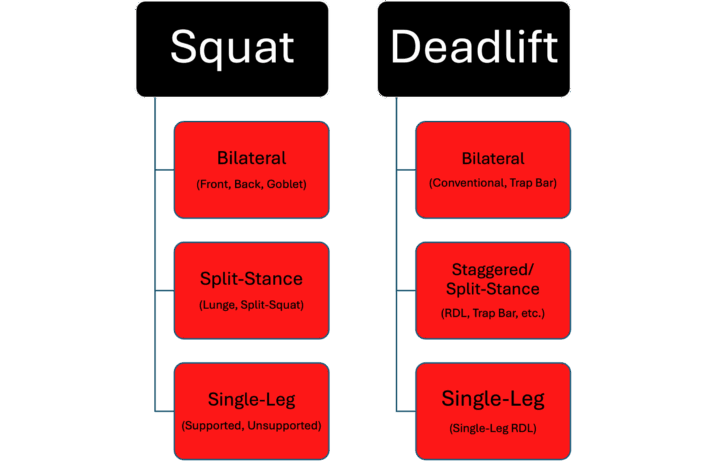
Big bang, bilateral variations like back squats, front squats, and conventional deadlifts?
Split-stance exercises like split-squats, lunges, or staggered stance deadlifts? OR
Truly single-leg activities like squats and RDL’s?
Well I’d give you a second to think about it, but I think you already know my answer…
In an effort to touch all the bases, my goal is to train all 3 variations of the squat and deadlift pattern whenever possible in my programs.
Now keep in mind I may not train all these patterns and positions in one training program, let alone one workout.
Many times I’ll find regressed variations to make certain exercises less complex and/or more appropriate for a given client/athlete.
And lastly, most people will have to earn the right over months – or even years – to unlock them all and be able to execute them with proficiency.
But I think there are unique benefits of all three exercise variations, and there isn’t one “all encompassing” option that gives you everything you need to build robust and resilient clients and athletes.
So without going full-on “Deep Dive” here, let’s dig a bit deeper here and see why you should consider keeping all 3 variations of squats and deads in your programs….
Bilateral Benefits and Variations
Bilateral lifts are great for a variety of reasons:
Improved stability and control due to a wider base of support (BOS),
That increase in stability and control also allows for increased force production, and
Overall they’re less complex than split-stance and single-leg lifts that have an increased demand for stability and control.
So if you’re thinking about driving outputs or increasing force production, bilateral lifts are the way.
Here are a couple of my favorite variations:
Split- and Staggered-Stance Benefits and Variations
Split- and staggered-stance lifts definitely provide some unique benefits:
Maintaining (or improving) alternating hip function and/or hip separation (think one hip flexing while the opposite one extends),
Reducing asymmetries in motor control or strength between legs,
Enhances/reinforces foot contacts, stability and control from the ground up, and
Creates/maintains the ability to turn and rotate.
So if you’re thinking about exercises that can improve force production to a degree, but that are also awesome for building symmetry, stability and motor control, then split-stance exercises are great.
Again, here are some quick tutorials, along with a few favorites:
Single-Leg Benefits and Variations
Last but not least, we have our “true” single-leg activities where one foot/leg/hip is on an island.
These are tough and definitely bring some unique benefits to the table:
TRUE single-leg stability and control because that leg is on an island,
Can further reduce asymmetries in strength and motor control, and
Can also help reinforce solid foot contacts, stability and control with a very limited/narrow base of support.
And last but not least, tutorials and a few examples:
Summary
So there you have it – I feel both squatting and deadlifting are beneficial for athletes.
Are they all going to look the same?
Nope.
Are they probably going to perform one better than the other?
Yep.
But at the end of the day, I think there’s value and merit in not only training both patterns, but also training different variations for each as well.
If your goal is to create a well-rounded and robust athlete, this is one of the simplest ways you can cover all your bases.
Figure out which position or pattern looks best for each particular athlete, and then start building from there – because it’s not where you start, but where you finish that really matters.
Good luck and good training! MR
BTW – If you want to get my step-by-step progressions to build clients and athletes from the ground up, consider invest in either my Complete Coach Certification OR attending my Optimizing Movement Workshop in Arizona on April 11th and 12th!