


TRX Training
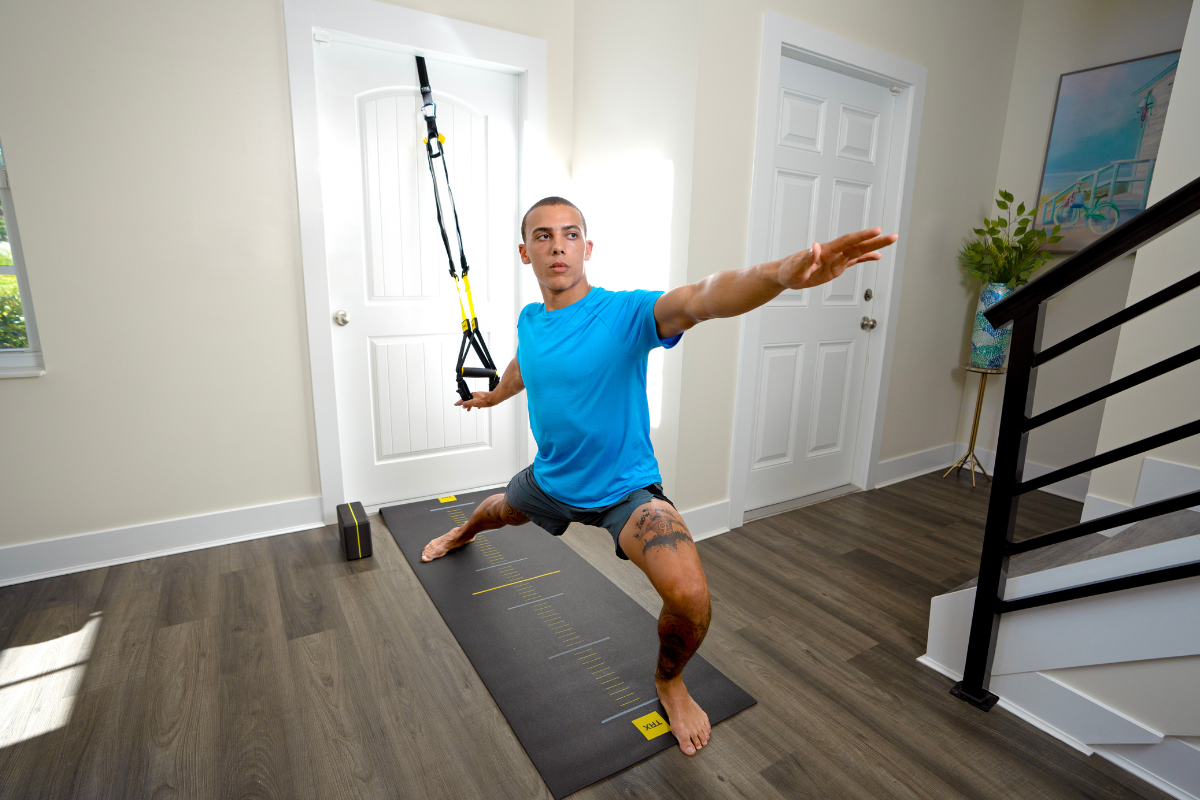
Yes, you can train hard in a tiny space, if you use compact movement patterns and efficient strength exercises. In this article, you’ll get simple bodyweight, TRX, and YBell routines designed specifically for tight rooms and busy schedules.
The theme is simple: minimal space, maximum results, you only need about 4-6 sq. ft. to do the full workout. Ready to turn your small space into a serious training zone? Keep reading.
The Small Space Mindset
Training in a small room is not a downgrade. It is a focus upgrade. With less room to roam, you use more vertical movement, more control on every rep, and tight, stationary patterns that keep you safe and efficient.
Big gyms like to brag about floor space, but the real progress comes from consistency, not square footage. Every move in this program is quiet, low-impact, and friendly to thin walls and touchy downstairs neighbors. When you commit to a home calisthenics workout plan, you realize that quality movement matters more than flashy space.
What You’ll Need to Get Started…
You can run the full workout in small spaces with zero gear, but this simple stack lets you level up over time: Mat → TRX Suspension Trainer → YBell. A mat is nice for grip and comfort, but a towel or carpet works fine.
A TRX Suspension Trainer can hang from a sturdy door anchor if you do not have a mount. A YBell replaces a dumbbell, kettlebell, and push-up handles in one compact shape, so you get full-body resistance without giant machines or long walking lunges. Each tool adds challenge, not clutter, making your small space exercise routine more effective.
TRX Lower Body Exercises
TRX lower body work keeps your legs strong, your balance sharp, and your hips moving well, even in a tiny room. The straps act like a safety rail, so your knees take less stress and your body feels more stable. You move mostly up and down in one spot, which is perfect when space is tight or the couch is basically staring at you.
1. TRX Squat
Sit your hips back like you are heading to a chair. Keep your knees in line with your toes. Use the handles to control how low you go and to stay steady. This foundational movement works perfectly for any small workout routine.
2. TRX Single Leg Squat
Use one leg to squat while the other hovers or taps lightly for balance. Hold the straps to help stabilize your hips and ankles. If balance feels shaky, keep your working foot closer to the anchor, use a smaller range of motion, and move slowly. These joint strengthening exercises build stability without requiring extra floor space.
TRX Push Exercises
TRX Push work trains your chest, shoulders, and triceps while you stand, so you do not need floor space or a bench. These moves fit narrow rooms because your body stays in one long line from head to heel. You control how hard it feels by where you place your feet, not by how big the room is.
1. TRX Chest Press
Lean your whole body forward with the straps in your hands. Keep your elbows around 45 degrees from your ribs. Brace your core so your hips do not sag or pike.
Step your feet closer to the anchor for more challenge, or step back to stand taller and reduce the load. Move in a slow, smooth line toward and away from the anchor, and avoid letting the straps rub hard on the sides of the door. For more push variations, explore resistance band chest exercises that also work in tight spaces.
TRX Pull Exercises
TRX Pull work keeps your upper body balanced, so all that pushing does not pull your shoulders forward. These moves hit your upper back, lats, and biceps while you face the anchor in a very small standing area.
In an apartment, set the door anchor high on a solid door that closes toward you, lock it, and gently test your body weight before you start.
1. TRX Row
Stand facing the anchor and lean back slightly with straight arms. Stay tall from head to heel and keep your ribs down. Pull your elbows back along your sides instead of shrugging your shoulders up.
You only need a small backward lean to feel the work, which makes it great for short hallways and tight corners. To change difficulty, walk your feet closer to the door for more load or farther away for less, keeping each rep slow and controlled so you do not rock into furniture or walls. Complement these with resistance band back exercises for complete upper body development.
Small-Space Full-Body Strength Exercises
You can train your whole body in one tight “Strength Block” using bodyweight plus a YBell, with no jumping and no roaming around the room. The goal is simple: strong, controlled reps that stay in one spot. The YBell and your body weight give you lower body, upper body, and shoulder work without eating up floor space.
1. YBell Goblet Squat
Hold the YBell close to your chest with elbows tucked near your ribs. Keep your chest tall and your heels grounded. Sit your hips back and down, then drive through your heels to stand. The weight in front keeps the movement vertical and very space-efficient.
2. YBell Floor Chest Press
Lie on your back with knees bent and feet planted. Hold the YBell over your chest with wrists stacked over elbows. Lower with a slow tempo, keeping elbows from flaring too wide. Press back up under control. This works as a clean push option when you do not have a TRX.
3. Overhead Press (YBell or Bodyweight)
Stand tall, squeeze your glutes, and brace your core. Make sure you have clear space above you. Press the YBell straight up, or press your hands overhead if using bodyweight. Keep the movement strict and vertical. No leaning, no drifting into lights or shelves. These shoulder workouts at home require minimal equipment and space.
Small Space HIIT Workouts: How to Get Started
HIIT in a small room means combining cardio and strength in short bursts while barely moving from your square of floor. You keep the impact low, the steps short, and the noise level neighbor-friendly. Pick a work time you can handle, like 20 seconds on and 40 seconds off, and cycle through a few tight, simple moves.
Sample Circuits by Level
Here are some sample workouts to get you started on your small space workout routine:
Beginner circuit (2 to 3 rounds):
Intermediate circuit (3 to 4 rounds):
Advanced circuit (4+ rounds):
All of these stay mostly in one spot and can be scaled by changing tempo or work time. If you’re looking for quick options, try a 10-minute workout at home that fits any schedule.
Small-Space Training: How to Get Great Results
Form and breathing are your secret weapons when space is limited. Move with control, keep your core tight, and exhale on the hard part of each rep. Focus on stability, not speed.
Set up your training zone first by checking how far your arms and legs can move without smacking a table or shelf. On small-space days, cool down with simple breathing, light stretching, and a short walk to let your joints and head reset. Consider incorporating low-impact cardio exercises to keep your heart rate up without disturbing neighbors.
How to Progress in a Small Room
You do not need more equipment to get stronger. You can progress by slowing your tempo, adding single arm or single leg holds, using elevated positions like feet on a step, or running AMRAP sets where you see how many good reps you can do in a set time.
Track reps, rounds, and work intervals in a notebook or app. Watch those numbers climb and let that be your proof, not the size of the room. A structured 4-week workout plan helps you stay consistent with your workout in small spaces.
Your Tiny Space Can Equal Big Results
Before, small spaces probably felt like a built-in excuse to skip workouts. Now you’ve got a space-efficient, full-body plan that’s scalable to your level and works whether you’re using just your bodyweight, a TRX, YBells, or nothing at all.
Small-space training isn’t a downgrade, it’s a smart way to stay consistent while building strength and mobility in almost any room. Stick with these sessions, adjust as you progress, and remember: You can build a powerful training routine anywhere with the right approach to your small space workout.
References
“Small Space Workouts You Can Do in Your Dorm.” New York University, meet.nyu.edu/life/small-space-workouts-you-can-do-in-your-dorm/. Accessed 9 Dec. 2025.
“Best Home Workout Equipment 2023.” Study Finds, studyfinds.org/best-home-workout-equipment-2023/. Accessed 9 Dec. 2025.