


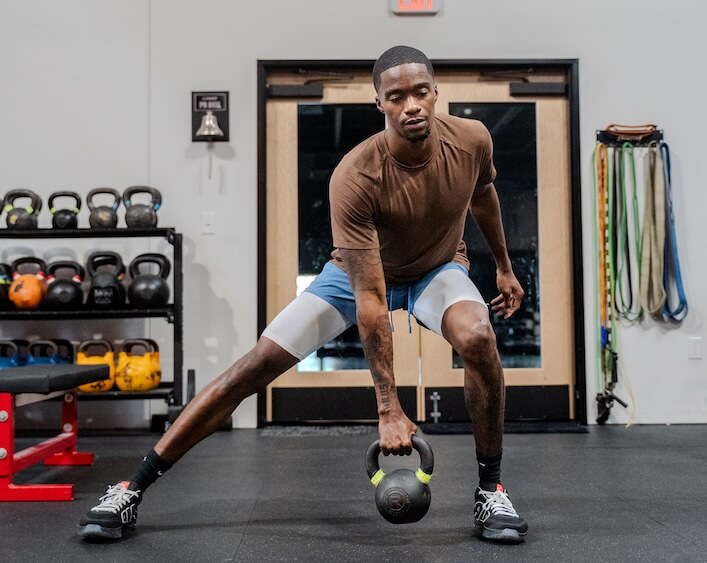
The first pro-basketball player I trained was an NBA all-star making 15 million dollars per year.
Let me set the stage for you here…
- Roy was an all-star two years prior, and obviously a dominant big man in that era,
- He had just come off a massive playoff run, with him and the Pacers almost upsetting the Miami Heat in their prime “Big 3” era, and
- I was a HUGE Pacers fan, nervous as hell, and seriously trying to hide my fan boy status when he came in the gym!
So needless to say, I felt A TON of pressure to get things right.
Now I’m going to speak for Roy here, but I feel like we had an amazing summer.
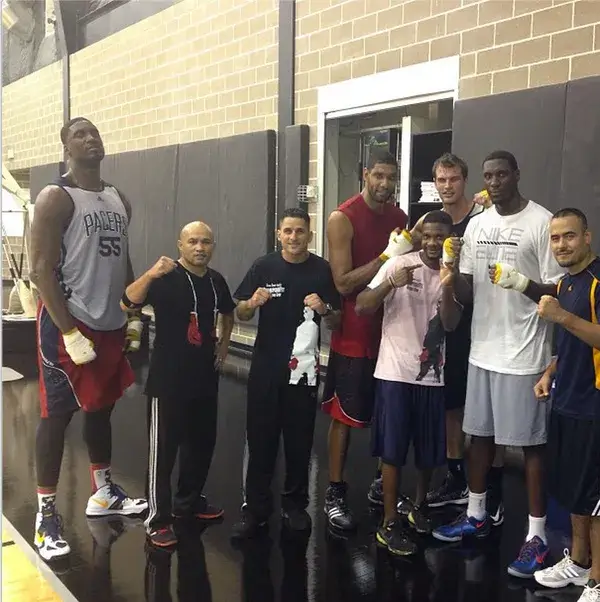
By the end, he was moving and feeling great.
He looked bigger and stronger than ever before (btw I took this pic, in case you were wondering!)
And the coolest part?
Both Frank Vogel (the Pacers head coach) and THE Gregg Popovich complemented me on how great he looked on the court!
But here’s the thing – I’d like to think I’ve learned a lot about training since then.
Like all of us, I’ve definitely made mistakes along the way.
So if you train pro hoopers…
…or if you aspire to train them someday…
…here are five goals I have for every pro hooper when we train together in the off-season!
Goal #1: Recapture Mobility and Movement Capacity
When I’m getting a hooper back after a long competitive season, the FIRST thing I try to do is recapture their mobility and movement capacity.
Specifically, I’m looking to unlock their feet, ankles, knees and hips.
It helps to think about mobility/movement options as your athlete’s “movement potential” – and the wider the foundation (within reason) the easier it is for them to distribute forces without overloading specific tissues.

Example: When a hooper has poor range of motion at the ankles, knees, and/or hips, they’re more likely to stress the patellar tendon and end up with some form of -itis or -osis.
The load can’t distribute, so it becomes focal.
This is why when I get an athlete back, I’m going to do a few things:
- Get them with our PT ASAP, to check them out and give them updated resets.
- Perform lower-intensity “reactive” work (i.e. sled drags, easy med ball throws, etc.) so I’m not creating interference. And
- Use a ton of exercise modifiers that shift their center of gravity (COG) BACK.
Now before I go on, I can’t stress this highly enough…
…you simply CANNOT skip this step.
The second an athlete starts performing more sport- and skill-specific work is the second they’ll start to lose range of motion.
Yes, you can mitigate these changes to a degree, but it’s not going to last forever.
And those sport-specific adaptations aren’t necessarily a bad thing, because they’re what make great athletes great.
BUT if you don’t give them enough of that “Buffer Zone” early in the off-season, you increase the likelihood of them running out of movement options before the seasons over.
And that’s definitely not a good thing!
Goal #2: Build Hypertrophy, Connective Tissue and Armor
The second thing I’m focused on during my off-season programming is rebuilding the muscles, tendons and connective tissues that support the athlete.
Over the course of a long competitive basketball season, we know that athletes tend to:
- Lose lean body mass,
- Overload and stress the Achilles and patellar tendons, and
- Just feel beat up and “fragile” by the end.
So while we’re working to recapture movement options, I’m also layering in higher volume/lower-intensity strength work to rebuild those tissues.
If I had to create a checklist of thoughts for the first block in my off-season programs, it would look like this:
- Higher volume workouts. Think building total time under tension and accumulating load over the course of a 4-6 week training cycle.
- Lower overall intensity. Primary goal early-on is to recapture ROM, so a general rule is to use loads that are challenging but that the athlete can breathe through (ie no valsalva!).
- Slower/longer time under tension. Basketball is filled with fast stretch-shortening cycle activities. Here, I want to go to the opposite end of that spectrum to offload those tissues and build the supporting areas around them.
- Working through “full” range of motion. This is context and athlete dependent, and may vary day to day. But the bottom line? Don’t sacrifice range for more load!
- Activities that shift COG back. Think anterior loaded squats, front-foot elevated split-squat variations, backwards sled dragging, etc. It’s a simple heuristic but exercises should feel “easy” for the athletes to get in and out of position.
I think if you just followed the rules above for the first training cycle of your basketball off-seasons, you’d see some really good results on the back-end!
Goal #3: Rebuild General and Sport-Specific Movement Patterns
Now you might call me crazy, because pros are literally the best in the world at what they do…
…so why would they need to rebuild their movement???
I tend to think of this like software – because if you use a lot of tech, we all know that sometimes software gets buggy.
Maybe an athlete got their knee dinged in a game, so they started to hinge more than squat in their defensive stance.
Maybe they were dealing with turf toe and are now pushing more with the outside portion of their foot.
The fact of the matter is, when most athletes come back they aren’t moving as well as I’d like, so I want to get ahold of that right from the jump.
So whether it’s a squat, a lunge, a hinge, acceleration, lateral movement, or anything in between, I like to take the first few weeks of the off-season to do a “clean install” and make sure my athlete is moving well FIRST.
To do this, literally just take the movements you do on the court and break them down into their constituent parts:
- Defensive Stance = Level Change = Squat
- Lunge Stop/Acceleration = Opposing Hip Actions = Step-ups and Split-Squats/Lunges
- Lateral Acceleration = Lateral Displacement of COM = Lateral Split-Squats
Start with the end goal/movement, and work backwards from there.
And if you don’t want to do all this yourself, never fear! I’m working on something now that will help.
Goal #4: Top Off the Force Production Bucket
One thing my non-fitness friends assume is that pro athletes are just CRUSHING heavy weights every time they’re in the gym.
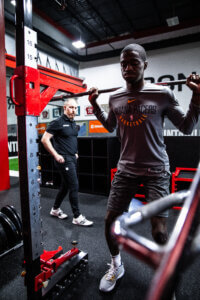
And look, I’m not here to tell you that force production ISN’T a key piece of the puzzle, because it absolutely is.
When I’ve worked with pro football and rugby players in their off-season, I’m consistently shocked at how strong they are – both in the gym, but even more importantly, on the field.
But when it comes to pro basketball players, I think the rules are slightly different.
One thing that’s always helped me is to remember pro athletes already have “The Juice.”
Now some may need more physical development than others.
Especially if I’m working with a younger pro who is still developing and growing into their body, they may need more force production early-on in their career than a grizzled vet.
But I’ll say it here just to be clear: It’s rare that pros are just crushing incredibly heavy weights
Instead, my goal is to push weights as necessary, but only to “top off” their force production bucket.
Get them back to whatever you deem to be that acceptable level where they feel strong and athletic, but where it’s not compromising their ability to move, be fast, or explosive.
A good general rule of thumb for force production is somewhere between 1.5-2x body weight in a major lower body lift (trap bar, safety bar squat, etc.).
This is where Chris Chase’s Trainable Menu concept comes into play, as the exercise you choose really comes down to the athlete standing in front of you.
Figure out what they like – and what they do well – and then train the heck out of it to get force production back up to snuff!
Goal #5: Make Sure They Feel GOOD!
To paraphrase Biggie…
“#5 coulda been #1 to me…”
Look, this is arguably the most important piece of the puzzle here, so I’m going to be direct:
If an athlete isn’t feeling great going into the pre-season, it’s going to be very difficult to get them feeling good as the season goes on.
As soon as the season hits, your athlete is going to be dealing with all kinds of nonsense.
Maybe it’s a crazy coach that conditions the sh*t out of them and makes them to 2-a-days for weeks on end.
Maybe they have something flukey where they bang knees with another athlete.
Or they just get into the throes of the season and end up playing a ton of minutes with not enough recovery.
Look the reality of the season is you’re trying to optimize performance, but it’s also just trying to stay healthy and ready to compete.
So now I’m going to ask you this:
Does it make any sense to have an athlete who feels crushed going into pre-season?
Or who is still managing nagging aches and pains?
Absoulely not.
Remember our “Clean Install” approach from above – I want an athlete feeling fresh, healthy and explosive going into pre-season.
And if I’ve done that, I feel like I’ve done a great job of setting them up for success.
Summary
There you have it my friend – 5 goals of my off-season workouts for pro hoopers.
I’ve been training pros for the better part of 15 years now, and I’d like to think the lessons I’ve learned along the way are not only valuable to me, but to you as well.
The next time you get the chance to train a pro (or even a lower level hooper) and get them right for the season, I really hope this article will help.
Thanks so much for reading and let’s MAKE IT a great day!
All the best,
MR
BTW – want to learn more about what I do?
If you want (or need) to learn in an online environment, check out my Complete Coach Certification.
Or, if you prefer live and in-person, I’ll be doing a 2-day workshop in Arizona on April 11th and 12th. You can find out more about my Optimizing Movement Workshop here!